- Oceania: Mount Giluwe
- South America: Ojos del Salado
- North America: Pico de Orizaba
- Asia: Damavand
- Africa: Kilimanjaro
- Europe: Elbrus
- Antarctica: Mount Sidley
Map of Volcanic Seven Summits
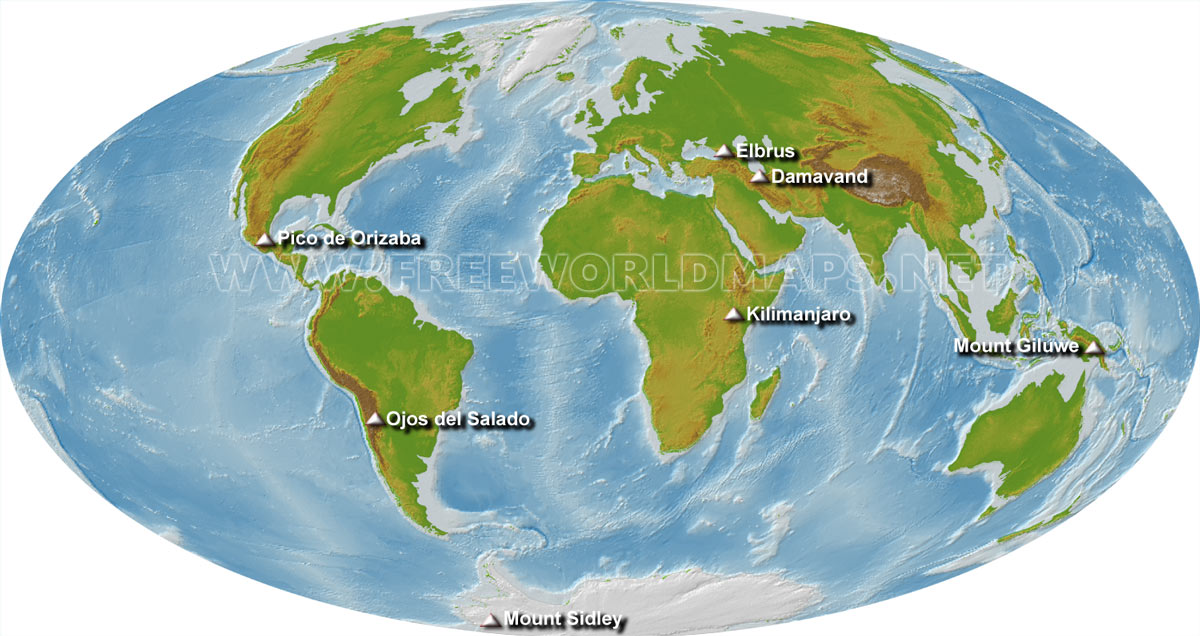
Map of the Volcanic 7 Summits
Click on above map to view higher resolution image
The Seven Volcanic Summits
The "Volcanic Seven Summits" are the highest volcanoes of each of the seven continents.
Related maps
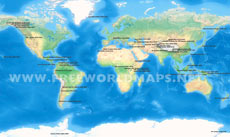
The Volcanic Seven Summits: Highest Volcanoes by Continent
The Volcanic Seven Summits is a mountaineering challenge comprising the highest volcanic peaks on each of the world's seven continents. Created as a counterpart to the traditional Seven Summits (the highest general mountain on each continent), this list highlights distinct volcanic landforms formed across diverse tectonic settings.
Because continental boundaries vary between geopolitical and geological definitions, this reference adheres to the standard geological and mountaineering consensus recognized by the international cartographic community.
---
The Volcanic Seven Summits at a Glance
| Peak | Continent | Elevation (m) | Elevation (ft) | Country | Volcano Type |
|---|---|---|---|---|---|
| Ojos del Salado | South America | 6,893 m | 22,615 ft | Chile / Argentina | Stratovolcano |
| Mount Kilimanjaro | Africa | 5,895 m | 19,341 ft | Tanzania | Stratovolcano |
| Mount Elbrus | Europe | 5,642 m | 18,510 ft | Russia | Stratovolcano |
| Pico de Orizaba | North America | 5,636 m | 18,491 ft | Mexico | Stratovolcano |
| Mount Damavand | Asia | 5,610 m | 18,406 ft | Iran | Stratovolcano |
| Mount Giluwe | Oceania / Australia | 4,367 m | 14,327 ft | Papua New Guinea | Shield Volcano |
| Mount Sidley | Antarctica | 4,285 m | 14,058 ft | Antarctica | Shield Volcano |
---
Geographic & Geological Profiles
1. Ojos del Salado (South America)
- Elevation: 6,893 m / 22,615 ft
- Location: Andes Mountains (Chile–Argentina border)
- Volcanic Status: Active stratovolcano
Ojos del Salado is the highest active volcano on Earth and the second-highest mountain in the Western Hemisphere behind Aconcagua. Situated on the edge of the Atacama Desert, hyper-arid atmospheric conditions leave the peak largely free of snow despite its extreme altitude.
2. Mount Kilimanjaro (Africa)
- Elevation: 5,895 m / 19,341 ft
- Location: East African Rift (Tanzania)
- Volcanic Status: Dormant stratovolcano
Kilimanjaro is a massive volcanic body comprising three major volcanic cones: Kibo, Mawenzi, and Shira. The summit point, Uhuru Peak on Kibo crater rim, makes Kilimanjaro the only mountain featured on both the classic Seven Summits and the Volcanic Seven Summits lists.
3. Mount Elbrus (Europe)
- Elevation: 5,642 m / 18,510 ft
- Location: Caucasus Mountains (Russia)
- Volcanic Status: Dormant stratovolcano
Located in the Caucasus range between the Black and Caspian Seas, Mount Elbrus is a double-peaked volcano covered by extensive glaciated fields. Under continental cartographic standards, Elbrus represents both the highest mountain and highest volcano in Europe.
4. Pico de Orizaba (North America)
- Elevation: 5,636 m / 18,491 ft
- Location: Trans-Mexican Volcanic Belt (Mexico)
- Volcanic Status: Dormant stratovolcano
Known in Nahuatl as Citlaltépetl ("Star Mountain"), Pico de Orizaba is the highest point in Mexico and the third-highest peak in North America. Its symmetrical snow-capped cone hosts Gran Glaciar Norte, Mexico's largest remaining glacier.
5. Mount Damavand (Asia)
- Elevation: 5,610 m / 18,406 ft
- Location: Alborz Range (Iran)
- Volcanic Status: Potentially active stratovolcano
Rising in northern Iran near the Caspian Sea, Mount Damavand holds prominent status in Persian folklore and geography. While no eruptions have been recorded in historical times, active sulfur-emitting fumaroles near the crater confirm it remains geologically active.
6. Mount Giluwe (Oceania)
- Elevation: 4,367 m / 14,327 ft
- Location: Southern Highlands (Papua New Guinea)
- Volcanic Status: Extinct shield volcano
Because mainland Australia lacks high volcanic topography, Mount Giluwe on the island of New Guinea represents the Australian tectonic plate. It is an ancient shield volcano featuring glaciated topography, alpine grasslands, and deeply eroded volcanic vents.
7. Mount Sidley (Antarctica)
- Elevation: 4,285 m / 14,058 ft
- Location: Executive Committee Range, Marie Byrd Land (Antarctica)
- Volcanic Status: Extinct shield volcano
Mount Sidley is the highest volcanic peak in Antarctica. Deep within Marie Byrd Land, its summit features a massive 5-kilometer-wide (3.1 mi) crater caldera. Due to extreme polar isolation and severe climate, it is logistically the most difficult summit to reach on the list.
---
Frequently Asked Questions (FAQ)
What is the difference between the Seven Summits and the Volcanic Seven Summits? The Seven Summits includes the highest points on each continent regardless of mountain type (e.g., tectonic block mountains like Everest or Aconcagua). The Volcanic Seven Summits exclusively lists the highest mountain of volcanic origin on each continent. Only Mount Kilimanjaro and Mount Elbrus qualify for both lists.
Which peak is logistically the hardest to complete? Mount Sidley in Antarctica is considered the most difficult due to extreme geographical isolation, harsh siberian-type winds, and the requirement for specialized polar expedition aircraft.
Are all of the Volcanic Seven Summits active? No. Ojos del Salado and Mount Damavand are active or active-fumarolic. Mount Kilimanjaro, Mount Elbrus, and Pico de Orizaba are dormant. Mount Giluwe and Mount Sidley are extinct volcanoes.