These seven summits are:
- Oceania: Puncak Trikora
- South America: Ojos del Salado
- North America: Mount Logan
- Asia: K2
- Africa: Mount Kenya
- Europe: Dykh-Tau
- Antarctica: Mount Tyree


Map of the 7 second summits
Click on above map to view higher resolution image
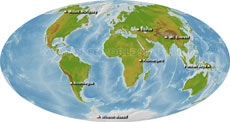
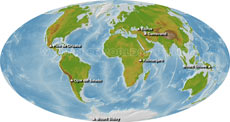
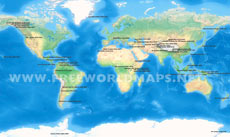
The Seven Second Summits consist of the second-highest mountain peaks on each of the world's seven continents. While the classic Seven Summits is the most recognized climbing milestone, mountaineers and geographers widely regard the Seven Second Summits as a far more formidable technical challenge.
Featuring peaks with extreme technical difficulty, harsh climate conditions, and high objective danger—such as K2 in Asia and Mount Tyree in Antarctica—this list represents the pinnacle of high-altitude alpine exploration.
---
| Peak | Continent | Elevation (m) | Elevation (ft) | Country | Mountain Range |
|---|---|---|---|---|---|
| K2 | Asia | 8,611 m | 28,251 ft | Pakistan / China | Karakoram |
| Ojos del Salado | South America | 6,893 m | 22,615 ft | Chile / Argentina | Andes |
| Mount Logan | North America | 5,959 m | 19,551 ft | Canada | Saint Elias Mountains |
| Dykh-Tau | Europe | 5,205 m | 17,077 ft | Russia | Caucasus Mountains |
| Mount Kenya | Africa | 5,199 m | 17,057 ft | Kenya | Mount Kenya Massif |
| Mount Tyree | Antarctica | 4,852 m | 15,919 ft | Antarctica | Ellsworth Mountains |
| Puncak Trikora (or Puncak Mandala) | Oceania | 4,750 m | 15,584 ft | Indonesia | Jayawijaya Mountains |
---
---
While the traditional Seven Summits attract far more media attention, high-altitude expedition leaders generally consider the Seven Second Summits a much harder physical and technical test:
1. Extreme Technical Difficulty: Everest, Elbrus, and Kilimanjaro are largely non-technical endurance ascents. By contrast, K2, Dykh-Tau, and Mount Kenya require advanced rock and ice climbing expertise. 2. Severe Isolation: Peaks like Mount Tyree and Mount Logan demand self-sufficiency in extreme polar environments where emergency evacuation is nearly impossible. 3. Fewer Established Routes: Unlike Everest or Aconcagua, which feature fixed ropes and heavy commercial support, routes on the Second Summits remain largely wild and uncommercialized.
---
Who was the first person to complete the Seven Second Summits? Italian legendary mountaineer Hans Kammerlander claimed the first completion in May 2012. Austrian climber Christian Stangl also completed a verified ascent sequence shortly thereafter.
Is K2 really harder to climb than Mount Everest? Yes. K2 has a significantly higher mortality rate than Everest due to severe weather unpredictability, steep avalanche-prone terrain, rockfall hazards, and extreme technical demands above the 8,000-meter "Death Zone."
Which mountain is the second-highest in Australia/Oceania? Under the Messner list (which includes the entire island of New Guinea), Puncak Mandala (4,760 m) or Puncak Trikora (4,750 m) take the second spot behind Carstensz Pyramid (Puncak Jaya). Under the Bass list (restricted to mainland Australia), Mount Townsend (2,209 m) is second to Mount Kosciuszko.